Air-to-Air Heat Pump Installation in Plymouth
An air-to-air heat pump heats and cools individual rooms using electricity far more efficiently than any conventional electric heater. It has two parts connected by a pair of insulated refrigerant pipes and a cable: an outdoor unit, which collects heat from the outside air, and one or more indoor units, which release that heat into your rooms. In summer the cycle reverses and the indoor unit takes heat out of the room instead.
We design and install these systems for homes across Plymouth — single rooms, whole flats, family houses, loft conversions, extensions and garden offices. This page explains how we plan an installation, what happens on the day and what you should expect afterwards.
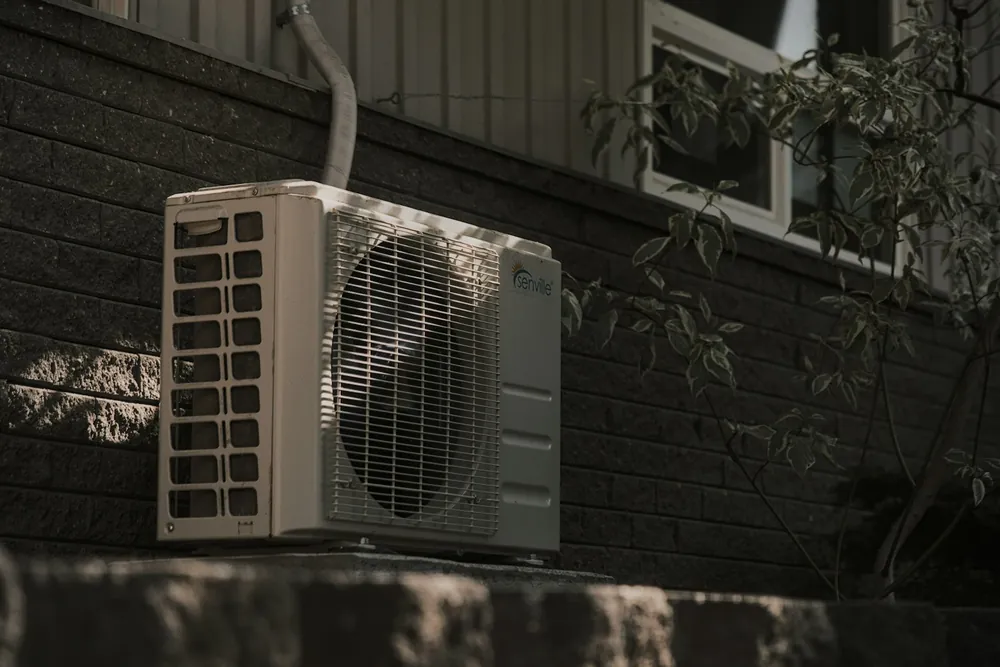
How an Air-to-Air Heat Pump Works
Inside the system is a refrigerant that boils at a very low temperature. In the outdoor unit, a fan draws air across a coil; the refrigerant absorbs heat from that air and evaporates, even when the air is close to freezing. A compressor squeezes the vapour, which raises its temperature sharply. The hot refrigerant then travels through the pipework to the indoor unit, where a second coil releases the heat into the room as a gentle flow of warm air. The cooled refrigerant returns outside and the cycle repeats.
Because the system moves heat that already exists rather than generating it, the electricity it uses is a fraction of the heat it delivers. Manufacturers publish a seasonal efficiency figure (SCOP) for each model; real-world results depend on the home, but a well-sized and well-installed system in Plymouth’s climate typically delivers between two and a half and four units of heat for each unit of electricity.
Is It Right for Your Home?
Air-to-air heat pumps work particularly well where:
- the home is heated by electric storage heaters, panel heaters or portable heaters, which are expensive to run;
- you want to heat specific rooms — a living room, bedrooms, a home office or a loft room — rather than the whole house at once;
- a room is outside the main heating system, such as an extension, conservatory or garden room;
- you want cooling in summer as well as heating in winter;
- there’s no space for a hot water cylinder, which an air-to-water system needs.
They’re less suitable as the only heating in a large, poorly insulated house with many small rooms, or where you need a system that also heats your hot water. In those cases an air source (air-to-water) heat pump may be the better choice, and we’ll say so at the survey.
Single-Room and Multi-Room Systems
Single split
One outdoor unit serving one indoor unit. This is the simplest and most efficient arrangement, ideal for a main living area, a bedroom or a home office. Several single splits can be fitted side by side, which gives each room its own independent system.
Multi-split
One larger outdoor unit serving two to five indoor units. It keeps the outside of the house tidier and suits flats and terraces with limited wall space. Each indoor unit still has its own controls and temperature.
Indoor unit styles
Most homes use high-wall units, which are discreet and spread air well. Floor-standing consoles suit rooms with low ceilings or sloping loft walls, and ducted units can hide the equipment in a ceiling void in larger projects.
The Survey: How We Size Your System
Getting the size right matters more than the brand. An undersized unit struggles on cold mornings; an oversized one cycles on and off, wastes energy and can be noisier. At the free home survey we:
- measure each room and note windows, external walls, insulation and ceiling height;
- calculate the heat each room loses on a cold day, so the unit can keep up in winter;
- agree where the indoor units will look and work best — usually high on an internal-facing wall with clear airflow;
- find a suitable position for the outdoor unit, considering noise, neighbours, airflow and drainage;
- plan the pipe and cable route, including any trunking, and how condensate water will drain;
- check your consumer unit and electrical supply for a dedicated circuit;
- confirm whether the installation is likely to qualify for the £2,500 grant.
You then receive a written quote with the recommended equipment, the price, what’s included and an installation date.
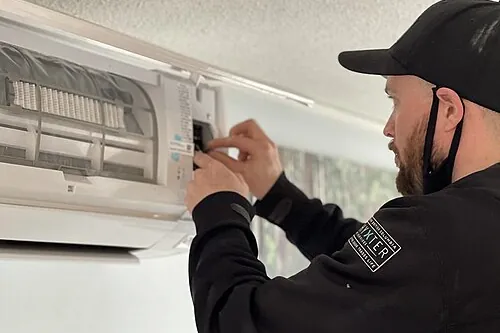
What Happens on Installation Day
Protect and prepare
We cover floors and furniture, then mark out the indoor unit bracket and the route through the wall.
Mount the indoor unit
A small core hole carries the pipes, cable and condensate drain outside. The indoor unit is fixed and levelled.
Fit the outdoor unit
The outdoor unit goes on wall brackets or a ground stand, with anti-vibration mounts and clearance for airflow.
Connect and test
Refrigerant pipework is connected, pressure-tested and evacuated. All refrigerant work is carried out by F-gas qualified engineers, as the law requires.
Electrics and commissioning
The system is wired to its own circuit, switched on, tested in heating and cooling, and set up with you.
A single room is usually finished in a day. Multi-room systems take one to three days depending on the number of rooms and pipe runs. There’s no need to drain any heating system or change radiators.
Planning Permission and Building Rules
Many heat pump installations on houses in England are classed as permitted development, so no planning application is needed, provided certain conditions on size, position and noise are met. Extra rules apply in some situations:
- Listed buildings need listed building consent for external units.
- Conservation areas — of which Plymouth has several, including the Hoe, the Barbican and Stoke — restrict units on walls facing a road.
- Flats usually need the freeholder’s or managing agent’s permission, and there are stricter size limits on blocks of flats.
We check these points at the survey and tell you if an application or permission is needed before any work goes ahead.
Useful Official Guidance
- Planning Portal: heat pumps and planning permission — the official guide to when heat pumps need planning permission.
- Plymouth City Council: conservation areas — check whether your street is in one of Plymouth’s conservation areas.
External sites open in a new tab. We’re not connected to or endorsed by any of these organisations.
Adding Rooms Later
You don’t have to do the whole home at once. Many owners start with the living room, see how well it works through a winter and a summer, then add bedrooms or a home office. If you think you’ll expand, tell us at the survey: we can choose a multi-split outdoor unit with spare capacity or plan positions so additional single splits fit neatly alongside. Bear in mind the grant can only be claimed once per property, so it’s worth planning the main installation carefully.
Living With Your Heat Pump
Most systems come with a remote control and many can be controlled from a phone app. For the best efficiency, set a steady temperature rather than switching on and off, and use the timer to bring rooms up to temperature before you need them. Clean the indoor filters every few weeks — it takes a couple of minutes — and book an annual service to keep the system running well and protect the warranty.
Typical prices in Plymouth
A single room is the most affordable starting point. You can add rooms later, and an eligible installation can have £2,500 taken off.
- Single-room air-to-air heat pumpAbout £1,500 to £3,500
- Two-room system (multi-split)About £3,000 to £6,000
- Whole-home system (4+ rooms)About £5,000 to £12,000+
- Air source heat pump (air-to-water)About £8,000 to £14,000
Guide prices only. Every home is different, so your fixed price comes in a written quote after a free home survey. See full pricing.